Showing posts with label ET -SAMR. Show all posts

Friday, April 7, 2017

The Substitution Augmentation Modification Redefinition (SAMR) Model: a critical review and suggestions for its use

Hamilton, E., Rosenberg, J. & Akcaoglu, Mete. (2016). The Substitution Augmentation Modification Redefinition (SAMR) Model:  a critical review and suggestions for its use.  Tech Trends, 60, 433-441.  doi: 10..1007/s11528-016-0091-y

Summary
This article analyzes the use of the SAMR method in K-12 education, offering a critical review of the SAMR method.  The article argues that the creator of this method, Puentedura, offers limited explanations and details to help teachers understand and use the SAMR model.  As a result, the authors note there are many different interpretations of the model in action. The authors also note three main problems with the SAMR model:  1)  It does not take into account the context of the classroom or the complex systems teachers work in. 2) Its structure is too rigid.  3)The SAMR model emphasizes product over process. The authors fear that putting focus on a product, may result in forgetting the importance of the processes that are so important to the learning process.   The authors end with suggestions for how the SAMR model can be refined and clarified so it more clearly identifies when use of the technology is best suited to the needs of learners. They also suggest getting rid of the hierarchical structure, because it suggests that only the Redefinition and Modification stages have value to student learning.

Analysis
I found the article very interesting.  Like many teachers, I was shown the hierarchical visual of the SAMR method, and it seemed to make sense.  It provided a simple direction to follow as I began incorporating technology into lessons after joining a one-to-one device school. But I did get the message from my administrators, who first introduced me to this concept, that there was an expectation that I would create assignments that consistently used technology at the higher two levels of the SAMR model.  The authors in this article, though, point out that sometimes substitution can be a valuable part of a lesson, and sometimes the use of technology for a learning experience does not improve upon that experience.  The SAMR model is really very simplistic and does not take into account the many factors a teacher balances inside a classroom.  I do see it as a guide, but would like to see the model developed more so that teachers could have a better understanding of how to use technology to best serve their students and so that administrators would not assume that any teacher creating lessons that do not fall into the top two levels of this model, might have a perfectly good reason for not making that change.

Tuesday, November 1, 2016

The SAMR Model as a Framework for Evaluating mLearning.

Frey, Jennifer

ET

Romrell, D., Kidder, L. C., & Wood, E. (2014). The SAMR Model as a Framework for Evaluating              mLearning. Journal Of Asynchronous Learning Networks, 18(2), 79-93.

Summary:

This article uses the SAMR model as a framework for learning via a mobile device. It states that substitution is made without functional change, Augmentation is made with functional improvements, Modification occurs since learning activities are redesigned and redefinition occurs since it allows for the creation of tasks that could not have been done without this technology. The SAMR model can be used to assist with decisions regarding how to use mobile devices in education.

Evaluation:

I initially read this article because I had never heard of mLearning and wanted to know what it was. This article not only defined it but gave a great example of how one of the learning models is used to help educators. I liked this article since it went into depth about the use of mobile devices and how the SAMR model relates.

Friday, October 14, 2016

SAMR and Bloom's


McClanahan, Lydia
ET
SAMR. (n.d.). Retrieved from http://www.schrockguide.net/samr.html

 
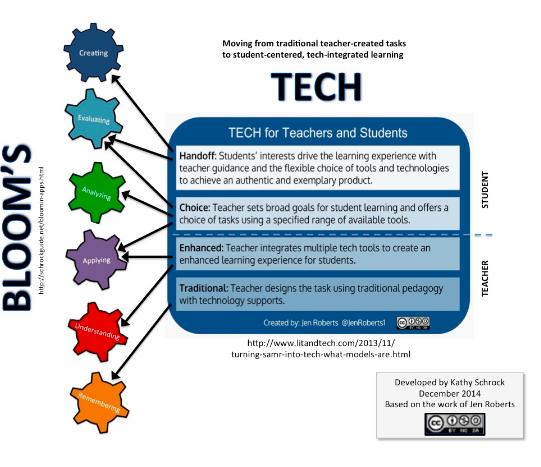
Kathy Schrock's SAMR + Bloom's article emphasizes the need for teachers to plan and align redefinition tasks with higher order thinking skills as outlined in Bloom's. She argues that creative tasks outlined in the modification and redefinition levels of SAME  are often limited by the lower order thinking skills on Bloom's, knowledge and recall.  The higher level tech tasks must  be matched by higher order thinking skills for creation and assessement according to Schrock as indicated by the image above.

Schrock's article not only helped my understanding of the SAMR model, but it also reminded
me that in creating rigorous instruction, a variety of  tasks, assessments and types of thinking must be considered.   Schrock's article pushes for a synthesizing of the familiar with what might be considered unfamiliar for many teachers. Introducing technology for some is unfamiliar and Substitution is a comfortable place to stay. Schrock however, helps those of us veterans, who might be used to pen and paper, the traditional, consider how we can use what we know, what we are comfortable with to push towards more innovative, 21st century thinking and instruction.